


What is rotary swaging?
In rotary swaging, tool segments known as swaging dies oscillate rapidly and act radially on the workpiece. Together with the simultaneous axial feed of the workpiece, this produces a gradual, incremental forming process. Usually up to six dies rotate around the workpiece and act against one another in the radial direction. Depending on the machine design and operating mode, the dies strike the workpiece at frequencies of up to 40 strokes per second. In so-called “outer-rotor machines” non-rotating swaging dies can be used, allowing also the production of non-rotationally symmetric components (e.g. two-flat geometry, triangular geometries, etc.).
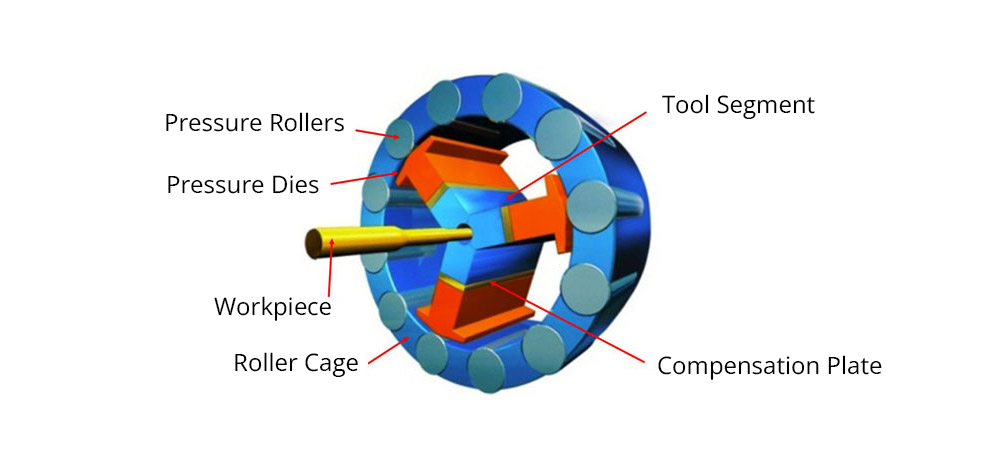
Depending on the machine design and application, the following process variants can be distinguished:
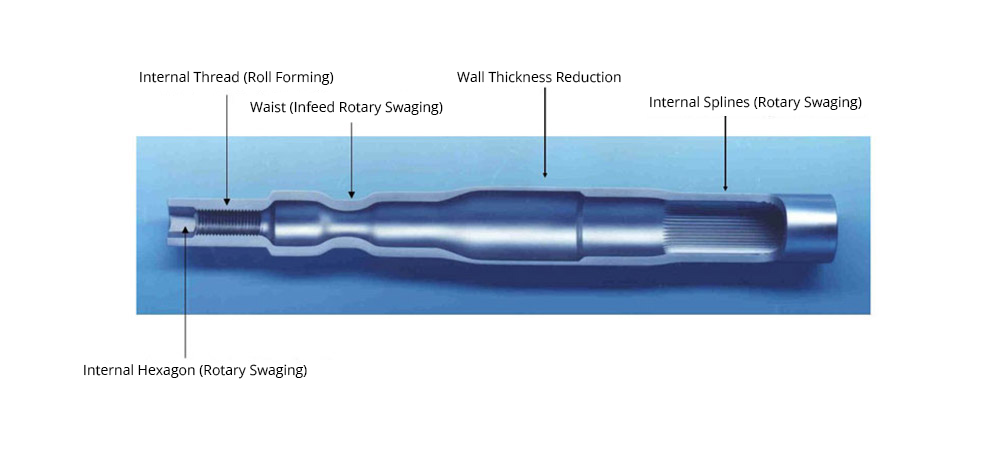
Infeed rotary swaging: Infeed rotary swaging is used to reduce the diameter starting from the end of a workpiece. The workpiece is fed axially into the rotating and oscillating dies, reduced in diameter by the tool entry cone – usually 10° – and then calibrated to size in the subsequent sizing section.
Plunge rotary swaging: By means of movable wedges beneath the swaging dies, plunge rotary swaging allows workpieces to be positioned between initially open tool segments. During the forming process, the closing of the tools (via wedge movement) enables diameter reductions and grooves to be produced at any desired position along the component. Through localized infeed and plunging, it is also possible to generate significantly steeper transition angles than 10°.
Mandrel rotary swaging: When tubes are rotary-swaged, an additional mandrel can be inserted to control and reduce the wall thickness or to shape complex internal contours direct on the workpiece, depending on the mandrel profile – including internal splines.
By combining different process variants and successive rotary-swaging stages, even highly complex component contours can be produced.
In addition to development, testing and prototype production, we offer contract manufacturing from small batches through to high-volume series. We have a range of rotary-swaging machines for processing component diameters from 3 to 60 mm, and tube diameters of up to 100 mm, using both infeed and plunge methods. Depending on the order volume, the individual machines operate semi-automatically or fully automatically. Fully integrated rotary-swaging transfer systems are often used for high-volume products.
Let our wide range of application possibilities inspire you.
Challenge us. Talk to us…